So this is a real thing? Has anyone actually laid eyes on a dead-tree copy of Gygax Magazine Issue Number 2?
Showing posts with label dragon magazine. Show all posts
Thursday, August 15, 2013
Sunday, June 10, 2012
Dragon Magazine Collection: June 2012
I've been looking for Dragon Magazine issue 140 for a while now. It features one of the few Larry Elmore illustrations that I consider to be Dungeons and Dragons art. In this case, a female cleric healing a stricken warrior. It's an imperfect illustration, from an old-school perspective, since the depicted scene is almost entirely devoid of menace. The female cleric seems unconcerned by the proximity of the giant, and the giant's glance towards the cleric seems half-hearted.
You can't help but be impressed, though, with Elmore's skill and attention to detail. Consider the treatment given to helmets, weapons, chainmail and how the snow interfaces with the two human subjects.
Labels:
dragon magazine,
illustrators,
larry elmore
Wednesday, April 11, 2012
Dragon Magazine Collection: April 2012
I possess only a handful of post-issue 142 Dragon Magazines.
Issue 142 of Dragon Magazine, published in February 1989, is a significant signpost in the history of DnD, for that issue contains the official preview for Advanced Dungeons and Dragons, 2nd Edition.
It never really occurred to me that I should be interested in what was said about Dungeons and Dragons, after the release of the 2nd Edition rules. After all, was 2nd Edition not the culmination of everything that had been, or could be, said about DnD?
I'm curious to hear whether I am mistaken in this regard, and if so, what wisdom can be gleaned from Dragon Magazines, post-issue 142.
If those post-issue 142 Dragon Magazines are worth pursuing, are there any issues that are particularly insightful?
Saturday, April 7, 2012
Females And Framing Less Controversial
Depending on your perspective, the art of Dungeons and Dragons became either more professional, or less visceral, as the game and its adherents grew ever more sophisticated.
Dragon Magazine 126, published in October 1987, features a cover by Daniel Horne, of a female ranger battling a skeletal frost giant. Sensibly dressed, and actively posed to fire an enchanted arrow at her adversary, there is little to criticize in this illustration, from a framing and art theory perspective.
Our heroine is posed in the foreground, as befitting the focus of the illustration. This is the ranger's story, not the frost giant's. Well lit, the froze wasteland setting is interesting, but is suitably muted to avoid detracting from the central narrative. The color choices are appropriate: blues and oranges, blacks and whites, reds and greens.
This was an exceedingly popular illustration, so much so that it was printed on heavy card stock and included in the binder version of the 2nd Edition AD&D Monster Manual.
Compare this full color illustration to that of the early Dungeons and Dragons artwork, much of which was printed in black and white. In those early pieces, the framing of the action was all wrong. So was the lighting. The most important portions of the narrative were often at the edge of the frame, or entirely off-screen. It would be unsurprising to hear criticism of that early artwork as amateurish and poorly framed.
So why would anyone prefer that old artwork to the more professional illustrations that followed? Is it simply nostalgia, or is there something that the old artwork communicated, that was lost in translation?
Labels:
daniel horne,
dragon magazine,
illustrators
Wednesday, April 4, 2012
No Stranger To Controversy
Back in the day, Dungeons and Dragons was no stranger to controversy. Besides attracting criticism for it's portrayal of gods, demons and devils, and attendant accusations of encouraging devil worship, there was ongoing concern about the depiction of naked bodies, predominantly those of women.
Those expressions of concern finally precipitated editorial changes at Dragon Magazine, in reaction to angry letters over what was perhaps the best cover of Dragon Magazine ever, that of Issue 114, published in October 1986.
The contents of Issue 114 were in themselves controversial, as Dragon Magazine once again published a revised Witch class.
However, it was David Martin's depiction of a naked Witch on the front cover of Dragon that resulted in a new artwork policy. That new policy was announced in Issue 117, following several months of argument and counter-argument between those who supported the depiction of nakedness in Dungeons and Dragons art and those who opposed it.
The early versions of Dungeons and Dragons were billed as a game for adults. As the game grew in popularity, it garnered more teenage and pre-teen players. It is little surprise, then, that there was heightened sensitivity amongst the staffers of TSR and Dragon Magazine to the issues of nakedness.
The Dragon Editorial staff concluded that the above depiction of a naked Witch crossed the line.
While it is easy for us to disagree with their assessment, we were not in the pressure cooker with the 1980's morality police, they were.
Labels:
david martin,
dragon magazine,
illustrators
Wednesday, February 8, 2012
Orgies Inc.
Others have provided their own observations and critiques of this article, appearing in Dragon Magazine #10, October 1977.
I, likewise, applaud the proposed DnD variant for experience point acquisition.
My purpose in posting this old Dragon article is two-fold: to once again highlight the delicious whimsy of old school Dungeons and Dragons art (the above orgy scene is by the incomparable David Trampier), and demonstrate the inclusiveness and tolerance apportioned to different gameplay approaches during the early years of the hobby.
The idea of rules variants is a big-tent approach to Dungeons and Dragons. The big-tent approach was thrown under the bus as DnD transitioned from game to property (and this happened a lot earlier than some of us would like to admit) and the DnD community was impoverished by it.
Here's the first page from the Dragon article on alternative experience point acquisition. For those of you who are not already familiar with its contents ... enjoy.
Labels:
david trampier,
dragon magazine,
experience points,
humour,
illustrators,
jon pickens,
orgies,
tsr
Sunday, October 23, 2011
Thursday, August 18, 2011
Trampier: Master Of Light And Shadow
You can't help but marvel at David Trampier's mastery of light and shadow. Here's a beautiful example ripped from the pages of The Dragon, Issue Number 12, Volume II, No. 6, February 1978.
This DAT illustration accompanies a preview of Andre Norton's Dungeons and Dragons-based book, Quag Keep. If you pay attention, you'll notice that the seated adventurer, in the foreground, is wearing a bracelet encrusted with oddly-shaped dice.
Wednesday, June 1, 2011
Sex In Dungeons And Dragons
One of the longest running gags in the early days of Dragon Magazine was the highly anticipated, never consummated episode of Sex In DnD, in the What's New cartoon, featuring the droll Phil Foglio and the randy and sexually-frustrated Dixie Null.For dozens of issues of Dragon magazine, What's New promised a Sex in DnD strip, but the episode was delayed for various increasingly-absurd reasons.
Early on, due to delays in the arrival of some "equipment" for the Sex in DnD episode, Phil and Dixie instead report on a new approach to miniature warfare, using your bed rather than a sandtable.

There are some distinct disadvantages to this wargaming approach, not the least of which is the combination of miniatures with pointed weapons and a waterbed.The introduction of color to the What's New cartoon precipitated a further delay in the Sex In DnD episode, for fear of overloading the colour generator. Instead, we are treated to a review of a new role-playing game, entitled "Price Wars" where you take the roles of competing FLG stores, trying to drive the other stores out of business. This can only end badly!
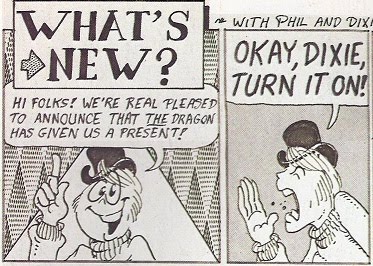
Dixie's suggestion that they spice up their private lives with a little cosplay, provides Phil with the inspiration for an episode on costumes for female characters.


Dixie's suggestion that they spice up their private lives with a little cosplay, provides Phil with the inspiration for an episode on costumes for female characters.

In observance of Valentine's Day, Phil and Dixie take a lover's stroll through the Dungeon. Well, it seemed like a good idea at the time.
The omnipresent Dragon Magazine editors kibosh several attempts to deliver on the Sex In DnD strip.
When the editors are not objecting to the fact that the nude models are wearing hats that are too small, they are ringing Phil and Dixie to remind them of their responsibilities to report on the newest games releases. Thanks Kim, way to ruin an anniversary!
All those out-of-shape role-players provide the inspiration for the next episode, on how to keep in shape when your principal form of exercize is reaching for the dice.

Robot cartoonists threaten the livelihood of Phil and Dixie, but Phil is more concerned about the possibility that he and Dixie will be unable to deliver on their promise to do a Sex In DnD episode than he is about the loss of his job.
The What's New cartoon is supposed to highlight more than just Sex In DnD, it is also a forum for reporting on the latest games releases and role-playing controversies. But sometimes Phil fails to take his responsibility seriously.
Finally! All of the impediments to a Sex In DnD strip have been overcome! After years of frustration, we finally get to the actual Sex In DnD episode, complete with gymnastic and other equipment.


A salesman from the local Minigame company spoils the fun of course, with the promise of a big fat paycheck in exchange for reviewing his latest game. His comeuppance, drawn and quartered by four draft horses, is too lenient, in my opinion.
The omnipresent Dragon Magazine editors kibosh several attempts to deliver on the Sex In DnD strip.
When the editors are not objecting to the fact that the nude models are wearing hats that are too small, they are ringing Phil and Dixie to remind them of their responsibilities to report on the newest games releases. Thanks Kim, way to ruin an anniversary!
All those out-of-shape role-players provide the inspiration for the next episode, on how to keep in shape when your principal form of exercize is reaching for the dice.
Robot cartoonists threaten the livelihood of Phil and Dixie, but Phil is more concerned about the possibility that he and Dixie will be unable to deliver on their promise to do a Sex In DnD episode than he is about the loss of his job.
The What's New cartoon is supposed to highlight more than just Sex In DnD, it is also a forum for reporting on the latest games releases and role-playing controversies. But sometimes Phil fails to take his responsibility seriously.
Finally! All of the impediments to a Sex In DnD strip have been overcome! After years of frustration, we finally get to the actual Sex In DnD episode, complete with gymnastic and other equipment.


A salesman from the local Minigame company spoils the fun of course, with the promise of a big fat paycheck in exchange for reviewing his latest game. His comeuppance, drawn and quartered by four draft horses, is too lenient, in my opinion.Several April Fool's Sex In DnD pranks are played on the What's New readers, such that even Dixie sees them coming a mile away. But what happens when the April Fool's prank IS the Sex In DnD episode?
Labels:
dragon magazine,
humour,
illustrators,
phil foglio
Saturday, May 28, 2011
Intelligent Swords
"Among magic weaponry, SWORDS ALONE possess certain human (and superhuman) attributes. Swords have alignment (lawful, neutral or chaotic), an intelligence factor, and an egoism rating (as well as an optional determination of their origin/purpose). These determinations are made as follows:" - Original Dungeons and Dragons, Book 2, Monsters & Treasure, page 27-28
Another feature of old-school Dungeons and Dragons that has been lost along the way: Intelligent Swords.
The possession of an intelligent sword was a mixed blessing. On the one hand, you had a powerful sword, with extra abilities that benefitted yourself and your party. On the other hand, there was the possibility of a battle of wills between the sword's possessor and the sword itself.
In ODnD, swords with an intelligence of 7 or greater also had an egoism factor. The egoism factor was the will of the sword. Swords with high intelligence and high egoism had a chance of dominating the possessor, thereby subverting the will of the player to pursue his own objectives. For example, a dominating sword might demand that the possessor encrust it with rare gems and beautiful filigree, fight certain monsters, surrender itself to another more worthy fighter, or mount a quest in keeping with the sword's purpose.
Considering the potential battle of wills between the player and the magic sword, some may wonder whether the advantages outweighed the drawbacks. It should be understood that an ODnD magical sword, possessing the same bonus, was more powerful than those of later editions. See my earlier post on magic swords for a further explanation. Because the advantages of magic swords were considerable, and because many players relished the challenge of owning an intelligent and willful sword, I don't recall an instances where intelligent swords were not retained by the player.
Labels:
dragon magazine,
fighter,
humour,
illustrators,
magic items,
magic swords,
magic weapons,
will mclean
Monday, May 24, 2010
Rewriting The History Of Dungeons and Dragons
There is an old axiom: history is written by the victors. While I do not own the magazine from which the original article was drawn, there is a brief history of the origins of Dungeons and Dragons, appearing on page 29 of the Best of Dragon Magazine I. Written by Gary Gygax, it summarizes his take on the development of D&D. By the time Gary wrote that article, D&D was well on its way to becoming a huge hit. For me, and many others on the periphery of the hobby, that article became the accepted history of the game for many years. As Dave Arneson did not have his own pulpit from which to preach, few were aware of his perhaps different perspective on the development of the game. The internet has been of great assistance in providing us with a more varied and fulsome account of the early days of the hobby.
Dave Arneson, who is credited with co-authorship of Original Dungeons and Dragons, played a different variation of the game than was revealed in those early D&D rules. In Dragons At Dawn, D.H. Boggs attempts to recreate that game. Mr. Boggs also provides us with the following alternate history of the Dungeons and Dragons game:
"One of the wargame rulesets that became a big influence on Arneson's fantasy campaign had been co-authored by Gen Con founder Gary Gygax. After Arneson demonstrated fantasy roleplay gaming to Mr. Gygax in the fall of 1972, Gygax became extremely enthused, and offered to write up the rules for Arneson and publish them. Arneson had no means to attempt this himself at the time and young Dave [24] had collaborated once before on a set of naval rules with the nearly decade older [33] and well connected Gary, so he readily agreed to have Gygax take the lead on typing up and publishing the rules. He mailed Gygax a 16 page manuscript of his rules and consulted with him by phone. This collaboration led to the first published fantasy RPG game in 1974; a game that has continued to grow and attract new players. However the 150+ pages as published by Gygax and business partner Don Kaye were somewhat of a compomise between the way each author actually played, with by far the majority of the rules coming from Mr. Gygax. It was a similar, and yet in many respects, a very different game from what Arneson had been playing with his group in Minneapolis."
I think the subtext of this alternate history is interesting. We are fortunate to have a wealth of information about the early days, via the various discussion boards and gaming sites. I like to think that, some 35-40 years later, old hatchets have been buried, festering wounds have been lanced, and those on either side of the Gygax/Arneson authorship debate are sharing the same pub table, enjoying a couple of pitchers of beer, a plate or two of nachos, and swapping stories of memorable D&D campaigns of yore.
Labels:
dave arneson,
dragon magazine,
dragons at dawn,
gary gygax
Wednesday, April 14, 2010
War Of The Angels: Todd Lockwood

In addition to his Orcus illustration, of which I earlier professed my fondness, Todd Lockwood produced several other pieces of black and white art, appearing in Dragon Magazine in late 1980.
Sixteen years later, Todd Lockwood would become better known for his color illustrations, having been instrumental in defining the look of 3rd Edition Dungeons and Dragons art.
In the process of discovering his later body of work, I came across another black & white Tom Lockwood illustration, which I believe is entitled War of the Angels. His mastery of light and dark, evident in the Orcus illustration, is re-affirmed in this piece.
Sadly, my ambivalence towards the "modern" D&D rulesets interfered with my appreciation for the artwork being produced by the Todd Lockwoods, Fred Fields and the other, later, D&D artists. While the early illustrators, like Dave Sutherland, Erol Otus and David Trampier will always strongly define the visual representation of D&D for me, its great to see that other artists like Todd Lockwood had a connection to the early days of the hobby, and, even then, made a strong impact on what I thought D&D was meant to "look like".
Labels:
dragon magazine,
illustrators,
rule sets,
todd lockwood,
wotc
Tuesday, April 13, 2010
Old School Illustrators: Todd Lockwood
Yesterday, I posted one of my favorite Orcus illustrations, which appeared in the October 1980 issue of Dragon Magazine. It was the product of a little-known D&D player -- and budding artist -- named Todd Lockwood. A few subsequent issues of Dragon Magazine also contained his artwork, but then inclusion of his artwork in Dragon Magazine ceased.Who knew, at the time, that this same Todd Lockwood -- who starting out playing D&D with his buddies in the early years of the hobby, and played while attending art college -- would join TSR sixteen years later, and become famous (along with Sam Wood) for defining the visuals of 3rd Edition Dungeons and Dragons.
I am embarrassed to report that I had no idea that Todd Lockwood, of Dragon Magazine #42 fame, is the same Todd Lockwood who would later create the concept art framework for 3E and 3.5E, and provide memorable covers for D&D products, such as The Forge of Fury (I bought the adventure and the related Black Dragon miniature, based on that cover alone) and City of the Spider Queen. A list of Todd Lockwood's impressive artistic rpg art credits can be found here, at Pen and Paper.
You can find Todd Lockwood's website here, and his blog, Behind The Water Heater, here.
Labels:
dragon magazine,
illustrators,
orcus,
todd lockwood,
wotc
Orcus: Ladies Man
I guess Orcus just had a way with the ladies.
Labels:
dragon magazine,
illustrators,
old-school monsters,
orcus,
paul jaquays
Monday, April 12, 2010
Fat And Manky Orcus
Tim Brannan of The Other Side blog wrote a recent post on the history of Orcus, along with a conversion to Unisystem. His post is well worth a read.
He also posted the above illustration, which first appears in The Dragon Magazine, Issue 42, October 1980. He was not sure who the artist was, nor when it was published. The illustration is by an artist by the name of Todd Lockwood. This is perhaps my favorite Orcus illustration, showing Orcus sitting lazily on his throne: I can't be sure whether he is snoring or drooling.
Labels:
dragon magazine,
illustrators,
old-school monsters,
orcus,
todd lockwood
Thursday, April 8, 2010
Player Versus Player In Old School D&D
Considering that Dungeons and Dragons was a product of wargamers, it should come as little surprise that there was a great deal of player versus player conflict in the early days of the game. Reading through the campaign accounts (certainly the ones being recounted by Gygax and his players) you will find numerous stories of players betraying each other.
The above cartoon from the pages of Dragon Magazine (yet another Will McLean original) shows a couple of adventurers playing poker, with one of the adventurers exclaiming of the winning adventurer, "Don't look now, Wiz, but isn't that a medallion of ESP he's wearing?"
Tuesday, April 6, 2010
Will McLean Humor From The Dragon Magazine
Most of you are familiar with the cartoons of Will McLean, as they appear on the pages of the original Advanced Dungeons and Dragons Dungeon Masters Guide, authored by Gary Gygax.
Several of Will McLean's cartoon panels also appeared in The Dragon Magazine. The above cartoon appeared in Issue 24, April 1979, on page 18. The caption reads:
"Y'know, Wiz, when you said the treasure was guarded by two Fighters, I sort of figured you meant Lords or Myrmidons or something in that line."
In the early days of the hobby, it was not unusual to mix historical periods, with tanks existing along-side magic, and science fiction elements cropping up in medieval fantasy. Just look to Expedition To The Barrier Peaks, or Temple Of The Frog, for evidence of this cross-genre gaming.
This cartoon panel by Will McLean ably lampoons that early propensity for cross-genre gaming.
Monday, April 5, 2010
Monty Haul Campaigns And Will McLean
One of the thorniest problems facing the designers of early versions of Dungeons and Dragons was that of the Monty Haul campaign. Monty Hall (for those few of you unaware of the cultural reference) was the host of a game-show called "Let's Make A Deal", in which undeserving, ridiculously-costumed contestants would be asked to choose between three doors, behind one of which was hid a fabulous prize, with the other two, booby prizes.
Similarly, Monty Haul D&D campaigns were those campaigns where players were handed arbitrarily large experience points awards and fabulous treasures by the DM, and rarely faced any risks. Letters detailing the horrors of those campaigns literally filled the pages of early Dragon Magazines.
The above cartoon appeared in The Dragon, Issue 24, April 1979. Even at this early stage of D&D's history, the Monty Haul campaign had acquired such infamy that Will McLean was spoofing it.
Similarly, Monty Haul D&D campaigns were those campaigns where players were handed arbitrarily large experience points awards and fabulous treasures by the DM, and rarely faced any risks. Letters detailing the horrors of those campaigns literally filled the pages of early Dragon Magazines.
The above cartoon appeared in The Dragon, Issue 24, April 1979. Even at this early stage of D&D's history, the Monty Haul campaign had acquired such infamy that Will McLean was spoofing it.
Subscribe to:
Posts (Atom)


