Showing posts with label microgames. Show all posts

Wednesday, July 25, 2018

The Fantasy Trip Kickstarter: A Good Deal?


After 35 years, Steve Jackson of Steve Jackson Games has finally re-acquired the rights to The Fantasy Trip, the tactical fantasy combat and light roleplaying game he developed in 1977.

Image result for melee wizard fantasy trip

The Fantasy Trip is comprised of a number of game books:  Melee, a game of tactical man-to-man combat; Wizard, a game of wizard duels;  Advanced Wizard, additional rules for Wizard characters; In the Labyrinth, role-playing and world building rules; Advanced Melee, expanded man-to-man combat rules;and 11 or so setting and pre-programmed adventure books.

Image result for advanced wizard into the labyrinth

The rights to The Fantasy Trip were owned by Howard Thompson, the President of Metagaming, and when Metagaming folded in 1982, Howard demanded an outrageous price from Jackson for the rights to the game, which Jackson refused to pay.  Thus, the game ceased to be published or officially supported after 1982.

The game retained a cult following, however, and people continued to play and support it.  Dark City Games even developed its own similacrum of The Fantasy Trip, called Legends of the Ancient World, and published numerous additional pre-programmed adventures, including The Dark Vale, which I previously reviewed on this blog.
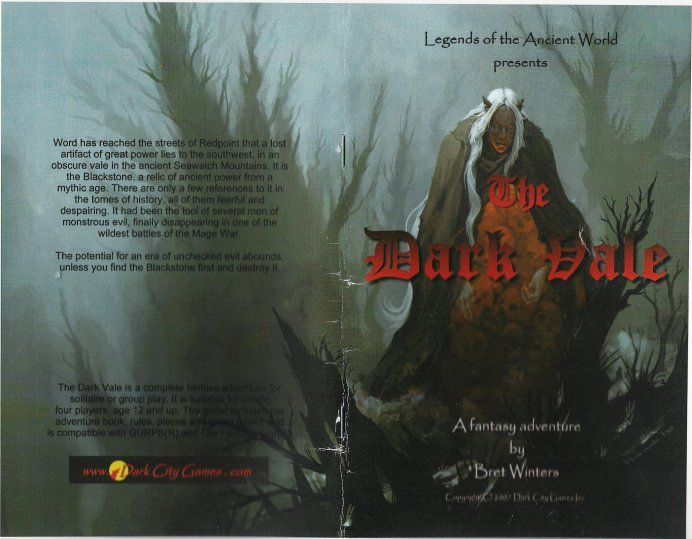
Image result for the dark vale city games

Jackson recently took advantage of a copyright law that permits a creator to re-aquire the rights to their intellectual property after 35 years.

Steve Jackson Games is currently running a Kickstarter to fund the production and distribution of a revised version of the game.

In considering whether the new Kickstarter for The Fantasy Trip is a good value, I looked at the original price of the various game books, and applied the inflation incurred during the intervening period.  The original publication years, price and the inflation based on the US Consumer Price Index are indicated below.


The basic pledge for The Fantasy Trip is $60, and it included, as of the Kickstarter launch, the material from all five of those publications. Using the above amounts, you are paying less, in today's dollars, than the cost to buy the original five game books when they were published back in the day.

Of course, this price is before shipping, but then you also need to factor in the extras that are being provided with this new printing, including dice (not included in the original game), a box to hold the game in, melee character pads, two sheets of mega-hexes, proper indexes in each book, and Tollenkar's Lair, Death Test, and Death Test 2 pre-programmed adventures (which are an additional $10 each of added value).  All of those extras add $40 of overall value, and more stretch goals are yet to come.

If you have never played The Fantasy Trip before and are interested in the game, or if you have the gamebooks and want a cleaned up version of the game to play again, you should check out the Kickstarter.

Saturday, May 17, 2014

Modern Microgames: Dark City Games

If you like the old Metagaming and other microgames, or The Fantasy Trip, you should check out Dark City Games, which produces pre-programmed adventures for a Melee / Wizard / TFT retroclone called Legends of the Ancient World.  I've already purchased seven of the Dark City adventures, and the rest look fantastic.  Here are the adventures I've already purchased.
And the ones below are on my to-buy list.  Check out Dark City Games!

Microgame Collection

I finally got around to unpacking my Microgame collection this evening.  It has been tucked away in three boxes in the basement since our move back in August, and I'd forgotten about several titles that had recently been added to the collection, including "A Fistful Of Turkeys."


There are a few titles left to acquire, but that exercise is not terribly urgent.  One of those has no placeholder at the moment: 20th Maine.  It is not the most expensive one to purchase, but several have sold on eBay without me paying attention to the listings.


Monday, April 28, 2014

Skeleton King: Magic Realm Ruins Expansion


The Skeleton King and retinue are not as dangerous as some of the other opponents in the Magic Realm.  However the Skeleton King casts curses on his opponents, and two of the skeletons still have relatively sharp weapons.  The fastest characters, with move times of 2, can run from these opponents, but until the attackless speed 3 skeleton changes tactics, he prevents any characters with a move time of 3 or greater from fleeing.

Sunday, April 27, 2014

Saturday, April 26, 2014

The Goblin King And Retinue: Magic Realm Expansion


With apologies to Liz Danforth, whose micro game art I have always loved, here is a mockup of the Goblin King and his Retinue, with Liz Danforth's artwork from TFT's Death Test repurposed for the occasion, including two archers, three axemen and one Goblin Shaman.

The Goblin King would be a special Treasure within Treasures site or treasure lair.  Among his possessions, a magical Dwarven Hammer or Throwing Axe (haven't yet settled on which it will be).

Sunday, July 15, 2012

Appendix N: Display Bookcases That Almost Were


With birthdays fast approaching, a decision had to be made whether to buy ten of these Costco bookcases for my Appendix N paperback, Microgame, RPG, LOTR Strategy Battle Game miniatures, and boardgames collections, or buy a new iPad for the wife.

The manufacturer would have even shipped me two FREE shelves per bookcase, giving me seven shelves per bookcase.  All I`d be required to do is pay for the shipping.

That would have worked out to 70 shelves on which to display my various collections.

But in the end the iPad won out, which is as it should be. 


Sigh.  I`m consoled by the knowledge that slightly superior bookcases were on sale at Costco about six months ago, so it seems probable that the opportunity to purchase some nice bookcases will come around, again, in the not-to-distant future.

Monday, May 7, 2012

Wanna Save $52 On Ogre Designer's Edition?


I just got off the phone with my Friendly Local Gaming Store, The Sentry Box, and they confirmed they are participating in the Ogre Designer's Edition Kickstarter Campaign.

You wanna pay $100 USD for your copy of Ogre Designer's Edition, rather than the $152 USD that Steve Jackson Games is asking from Canadian purchasers?  Then you'd better give The Sentry Box a call and place your pre-order with Don.

And let them know if you want any other Kickstarter items as well, and they may be able to purchase them for you.

Incidentally, kicktraq is predicting that Ogre Designer's Edition will garner $725,000 in pre-funding.  I'm guessing the number might end up closer to $800,000.

Wednesday, April 18, 2012

Microgames: The Castle by Mayfair Games


Among microgames, those microgames published by Mayfair Games are the most obscure. 

Before the microgame market went bust, Mayfair Games published four microgames (Transylvania, Space Empires, I.C.B.M. and The Castle). 

I have already reviewed Transylvania, a fun little game of vampires and angry villagers.  The Castle, designed by Neil Zimmerer, has a style similar to Transylvania, with minimalist rules and and stylized counters. While Mayfair Games' The Castle shares some superficial similarities with SPI's Deathmaze and TFG's  Valkenburg Castle, two other excellent fantasy microgames, there are some interesting differences. 


The premise of The Castle is outlined above.  This microgame is basically a dungeon-crawl through a castle.  The goal: rescuing and escaping with the princess in order to collect a 1,000 gold piece reward.  This microgame can be played solitaire or competitively.

Like most Mayfair Games microgames, the ruleset is abbreviated.  The Castle rulebook is a slim volume of 8 digest-sized pages, but contains all the rules you need to play this game.


The Castle employs a fold-up mapboard.  The mapboard includes hallways, doors and rooms, through which the characters will travel.  At the top of the mapboard are tables, representing the combat abilities of the monsters appearing thoughout the map, with the associated damage those monsters inflict on the characters.

This microgame includes a sheet of counters, with the top row of counters representing the characters (Wizards, Clerics, Fighters and the Princess), gold counters representing treasure and items, and black counters representing monsters. 

Characters start with the number of hit points indicated on their counter:  6 for Wizards, 8 for Clerics, and 10 for Fighters. 

Monsters, too, start with the number of hit points on their counters: 2 for Bats, 3 for Goblins, 4 for Zombies, 6 for Gargoyles, and so on.


The gold treasure and black monster counters are turned face-down, and one of each is placed randomly in every room on the mapboard.  Thus, each room has a monster and treasure, but at the beginning of the game, you don't know what monsters and treasure occupy each room.

Your rescue attempt is complicated by the fact that the princess is being held in a locked cell.  In order to unlock the cell holding the princess, you must locate two of the six keys that are scattered amongst those face-down treasure counters. 


There are six keys, two of each of three types of keys: A, B, and Skeleton (S) keys.  You need a combination of those keys (AB, AS, BS, or SS) to unlock the cell holding the Princess.  Thus, this game is not simply about following the most direct route to the Princess, you must enter other rooms to locate those keys.


As you investigate the rooms of The Castle, you will encounter monsters.  This game employs a unique combat system: you roll one six-sided die, and that die roll determines the damage inflicted by both the character and the monster.

The number on the die roll represents how much damage the character inflicts upon the monster.  So if you roll a 5, you do 5 damage to the monster.  In order to determine how much damage the monster inflicts upon the character, you must consult the related monster table, printed on the mapboard, like the table above. 

In general, the lower your dice-roll, the more damage the monster will inflict.  For example, if you are battling the Behemoth and roll a 1, you inflict 1 damage to the Behemoth, while the Behemoth inflicts 3 damage on you.

Friday, February 10, 2012

Microquests: Death Test 2

Every 1970's game design house was strongly affected by the success of TSR's Dungeons and Dragons game.

If you look at the history of such established chit-and-hex firms as SPI and Avalon Hill, you see mad scrambles to catch up to the phenomenal growth curve of TSR, and capture some of the role-playing game market.

Then there were upstarts, like Metagaming, that came onto the scene just as TSR was finding its legs. But, despite being contemporaries, and settling (initially) into discrete niches, you still find them trying to horn in on the success of D&D.

Like SPI and Avalon Hill, Metagaming desperately wanted to penetrate the roleplaying game market. Their unique business model was microgames; small format chit-and-hex games that could be carried anywhere, and played anytime.

But after Metagaming's success with the Steve Jackson-designed Melee microgame, and subsequent further success of the spellcaster-based follow-up, Wizard, Metagaming poured significant energy into expanding those two games, creating what they hoped would be a full-fledged RPG competitor to D&D. That expansion led to the creation of "The Fantasy Trip", being Advanced Melee, Advanced Wizard and In The Labyrinth.

With the departure of Steve Jackson from Metagaming, TFT would subsequently become GURPS.

One of the Metagaming Melee and Wizard supporting lines was a series of Microquest boxed supplements. These were small format boxed adventures, that provided everything you needed to run a pre-programmed game, in either solo or game-mastered mode. Those microquests were not terribly sophisticated, as they were typical hack-and-slash fare.


But they included the most wonderful cardboard counters!

The above counters are from Death Test 2, a maze and set of arenas below Thorz' palace, intended to test the character's mettle, in anticipation of eventual employment in Thorz' mercenary army. As I observed earlier, the combination of skeletons, weapon-wielding octopuses, and other assorted denizens, was welcome inspiration for our middle-school imaginations.

Saturday, January 14, 2012

Melee And Magic Realm Counters

It should come as little surprise that I like Magic Realm. It includes all sorts of features that I like in a game. A fast, diceless, player-skill combat system. A mysterious and unrevealed backstory. Player agency, with clear and deadly consequences for bad decision-making. A wealth of opportunities for both player cooperation and competition. A circumscribed game length of only one month (28 days), which turns victory into a race against the clock.

And most importantly? Counters. Lots and lots of counters.

Magic Realm is notorious for its fiddly bits and long set-up times. You can easily spend 45 minutes to an hour setting up Magic Realm. That may not seem like a long time, for those of you who enjoy spending hours, as they say in the modern D&D parlance, "building your character", but it does become a barrier to casual gameplay, when other boardgame setups take only minutes.

But those other boardgames don't have cool counters like Magic Realm does. And since i'm also a big fan of Melee and other chit-and-hex microgames, I really dig counters with artwork.

Here are a few Melee counters, juxtaposed with some comparable Magic Realm counters. Metagaming missed the boat with their counters, as they could have easily printed some of the monster and npc stats on the counters included with their various death test adventures.


Monday, January 2, 2012

Microgame Investment Opportunities

Instead of putting my money in Google shares, I should have bought a container of Metagaming's Invasion Of The Air-Eaters microgames.

In 1979, Air-Eaters retailed for $2.95. According to this top-rated eBay seller, the game is now worth $39.00.

That's a 9% average annual rate of return.

How's your RPG portfolio doing?

Thursday, December 29, 2011

Alien: Intruder And Xenophobe

Between the release of Chevski's Thousand Suns and Ridley Scott's Prometheus trailer, 2012 is shaping up to be the year of the science fiction old school renaissance.

Ridley Scott is directing Prometheus, and directed the original Alien movie. H.R. Giger gave us the look of the Alien antagonist, the Xenomorph. The above Giger image inspired Alien's Xenomorph.

That antagonist later makes its appearance in all sorts of unauthorized spin-offs.

The first of those two is the Xenomorph's appearance in a Task Force microgame from 1980, entitled Intruder.

Intruder was designed by Dennis Sustare, known for having designed the much beloved Bunnies and Burrows RPG and Dwarfstar's engaging, if somewhat arcane, Star Smuggler microgame.

Intruder is set in the near future, on the Deep Space Station Prometheus, orbiting the star Sigma Draconis.

An exploratory team brings back an alien life form, and is directed to keep the creature alive for study. When the creature escapes from the lab, this directive proves to be a deadly mistake.

If the premise sounds familiar, it may be because it is. That is the same premise that informs the first two Aliens movies.

The second unauthorized spin-off is a Bally Midway Arcade game from 1987, entitled Xenophobe. Xenophobe is obviously inspired by the Alien movie franchise, as the goal of the game is to rid various ships, bases and planets of alien infestations.


The game allows you to play one of nine different characters. Among them: Dr. Kwack, sporting a duck head; Mr. Brace, with a Quasimoto face; Col. Truth, the spock-eared; Mr. Fogg, crazy scientist hair and a Geordie visor; Dr. Udderbay and Col. Poupon, two female chaaracters; Mr. Eeez, with a green bug head; Mr. Zordiz, the James T. Kirk of the game; and Col. Shickn, with white hair and an eye-patch. The characters wear yellow, blue and red tunics, Some also wear black slacks, given the characters a look reminiscent of early Star Trek attire.

Wednesday, December 7, 2011

Microgames: Still Back-Filling My Collection

I have a pretty extensive Microgame collection, but that doesn't mean i've stopped my search to fill in the gaps. I recently chanced upon several Dwarfstar microgames at reasonable prices and added them to my collection. Still, there are a handful of games, included Helltank, that continue to elude me.


Monday, December 5, 2011

Revolt On Antares/Erol Otus: One Fine Young Artist

From the Forward (sic) to The Arduin Grimoire; Volume 1, by Dave Hargrave:

"Special Note. The artwork for this supplement is the sole doing of one fine young artist: Errol (sic) Otus. I'm only glad I'll be able to say ten years from now, 'I knew him when...'"

Erol Otus did not merely produce fantasy artwork during the late 70's and early 80's. He also rendered the science fiction artwork below, which graced the centre pages of the 1981 TSR Revolt On Antares minigame booklet.

Click to embiggen.

With the seeming-success of Metagaming's microgame line, other game companies jumped into the soon-to-be-crashing minigame market. That included TSR, SPI, Task Force Games, Chaosium, Mayfair Games, Heritage USA, Operational Studies Group, Steve Jackson Games, and FASA.
TSR's Revolt On Antares concerns a power struggle on Imhirros, ninth planet in the Antares system, on the fringes of Imperial Space.

Several noble houses, the Imperial government, and alien invaders vie for control of Imhirros using raw military power, alien artifacts, galactic superheroes, and hereditary psychic abilities to achieve their ends. Interplayer diplomatic efforts are encouraged in the rulebook, but there are no game systems to regulate diplomacy.

The game was designed for TSR by Tom Moldvay, who also designed Avalon Hill's Lords Of Creation. Two pieces of Erol Otus art appear within Revolt On Antares.

The game showed great promise, particularly when viewed through the lens of the above Erol Otus art.

Tuesday, November 8, 2011

Monday, August 1, 2011

Microgame Collection Update

My microgame collection is coming along quite nicely. I recently added a couple of titles, including Artifact, Goblin and Hitler's War. I'm missing most of the Dwarfstar Games, but I never collected those when they were first released, so they must be purchased from the resale market, meaning they are out of my price range (at least what i'm willing to pay).