Showing posts with label pat hidy. Show all posts

Friday, February 10, 2012

Microquests: Death Test 2

Every 1970's game design house was strongly affected by the success of TSR's Dungeons and Dragons game.

If you look at the history of such established chit-and-hex firms as SPI and Avalon Hill, you see mad scrambles to catch up to the phenomenal growth curve of TSR, and capture some of the role-playing game market.

Then there were upstarts, like Metagaming, that came onto the scene just as TSR was finding its legs. But, despite being contemporaries, and settling (initially) into discrete niches, you still find them trying to horn in on the success of D&D.

Like SPI and Avalon Hill, Metagaming desperately wanted to penetrate the roleplaying game market. Their unique business model was microgames; small format chit-and-hex games that could be carried anywhere, and played anytime.

But after Metagaming's success with the Steve Jackson-designed Melee microgame, and subsequent further success of the spellcaster-based follow-up, Wizard, Metagaming poured significant energy into expanding those two games, creating what they hoped would be a full-fledged RPG competitor to D&D. That expansion led to the creation of "The Fantasy Trip", being Advanced Melee, Advanced Wizard and In The Labyrinth.

With the departure of Steve Jackson from Metagaming, TFT would subsequently become GURPS.

One of the Metagaming Melee and Wizard supporting lines was a series of Microquest boxed supplements. These were small format boxed adventures, that provided everything you needed to run a pre-programmed game, in either solo or game-mastered mode. Those microquests were not terribly sophisticated, as they were typical hack-and-slash fare.


But they included the most wonderful cardboard counters!

The above counters are from Death Test 2, a maze and set of arenas below Thorz' palace, intended to test the character's mettle, in anticipation of eventual employment in Thorz' mercenary army. As I observed earlier, the combination of skeletons, weapon-wielding octopuses, and other assorted denizens, was welcome inspiration for our middle-school imaginations.

Wednesday, March 9, 2011

Wizards' Wizards And More Wizards


Earlier, I mentioned that the quality of The Fantasy Trip (TFT) micro-art reaches its zenith with Death Test.

Two TFT products precede Death Test: Melee and Wizard. I like the micro-art from both sets of counters. The art is minimalist but for the most part highly effective at communicating the essential character of the depicted Wizard.

Melee has its' bell-bottom wearing warriors and giants. Wizards, by way of contrast, introduces vaguely oriental-style 4- and 7-hex dragons, and trippy-tropey Wizards. Here are several of those Wizards, gracing, well, the Wizards' counters.

The first Wizard, above (or is that Sorceress?), you've seen in one of my earlier posts. It is Mistress J, with her blond hair a-fluttering, her cape a-flowing, and her armored bikini glinting in the torchlight. I posted this counter earlier, as it is one of my favorites from the Wizards set of counters. Simple, evocative micro-art. I wonder if she gets an armor bonus.

The next counter (below) is somewhat of a mystery. The figure suggests a female form, with the face in profile -- a Sorceress sporting a gossamer gown or dress. The upper, casting hand is oddly distorted, and the midriff, thighs and posterior have a strange, bloated quality (consider in particular the placement of the belly-button). I never used this counter during a game. I find it vaguely disturbing rather than entrancing. It's too bad, because there is something compelling about this piece of micro-art, particularly the hair, lower legs and feet, and the hand by the figures' side. The hair almost says Medusa. I'm not sure if the artist (Pat Hidy?) was going for a gossamer effect with a dress, or if that is a spell-effect enveloping the Sorceress.

Is this next counter Fu Man Chu or Dracula? Only the TFT player using this counter knows for sure. Consider the odd placement of the fingers. You don't notice these things when you are looking at the original 3/4" counter, but at this resolution, you can see the compromises the artist has to make to give these drawings some character, without mucking it up by adding too much detail. I love the fog or mist he is conjuring, you want to pick a spell like that for him, don't you, just to go with the over-all theme?


Who hasn't always wanted to play a speedo-sporting, wand-waving, pointy-shoe shod Elf, with droopy digits and weak wrists, like the one below? You even get to start his name with an "E". Ebberbobble? Elfy the Elf? Well, you get the idea, something silly or insipid. The ear and shoes give away his elfin heritage.


If you don't name the next Wizard Gandalf, when you use this counter to represent your character, there's something seriously wrong with you.

The next counter, the mysterious Wizard Q, inspired the "tween" me to write my own supplement for TFT, focused on clerics. Thankfully, that document is buried deep in the Spy Hill landfill. He's bald. He's knelling. And he's got a crystal ball. Which is odd, since scrying is not high on my list of activities when facing a death-duel against another Wizard. He should get a movement penalty for being on his knees. Having said that, there's no doubt about what fantasy trope he represents.


Here's the counter I often used to represent my character. Goatee-Wizard R. The illustration on this counter was sufficiently active that you felt like he was all wound-up, ready to spring into action at any moment.


This last counter is another female, who looks rather uncomfortable leaning as she does at a precarious angle. Her spell-casting efforts has caused her face to burst into flame. Perhaps she is part of the coven that is conjuring the dragon appearing on the front cover of the Wizards microgame.


Well, there's a meandering tour of some of the micro-art on the Wizards microgame counters. What I like about these counters, and TFT micro-art more generally, is that the art is sufficiently universal that you can put that counter down on the table, and anyone picking it can create their own backstory to fill in the character details.

Tuesday, March 8, 2011

Swashbuckling Octopii (And Other Horrors)

Following the success of Death Test, Metagaming published Death Test 2. Included in Death Test 2 are swashbuckling octopii, like the ones pictured here.

In addition to their handweapons -- either 3 swords or a sword and battleaxe -- the Octopii encountered in Death Test 2 also sport crossbows, which they can manipulate and fire with their tentacles.

I'm pretty sure that skeletons make their first appearance in The Fantasy Trip line of game products in Death Test 2. Prior to Death Test 2, the monsters and beasts encountered in The Fantasy Trip were giants, dragons, wolves, bears, goblins and such.
The illustrator for Death Test 2 is Roger Beasley, although the cover art for Death Test 2 is by Pat Hidy. The interior art for Death Test 2 is by Beasley, but it's hard to know whether he also produced the micro-art appearing on the game counters.


Sunday, March 6, 2011

The Fantasy Trip: Death Test Art


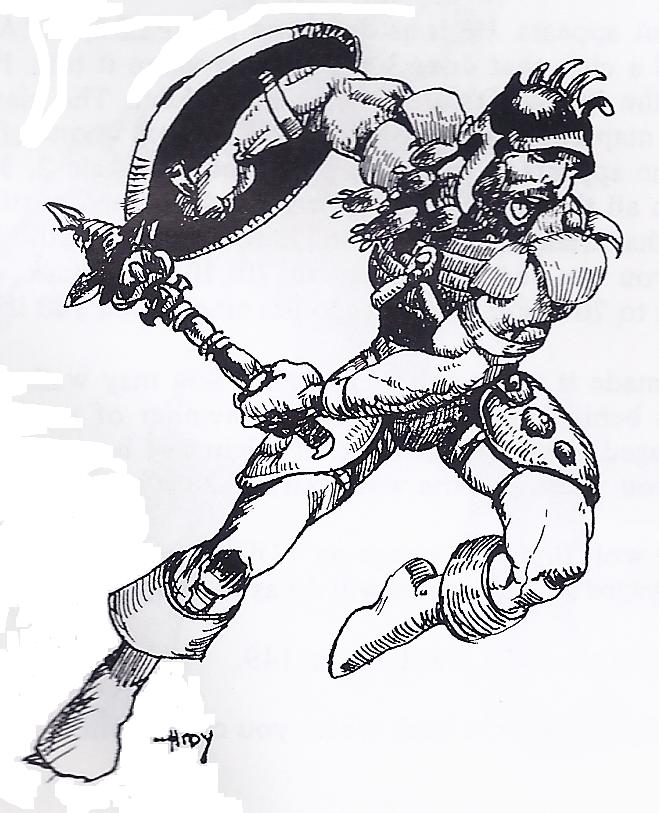
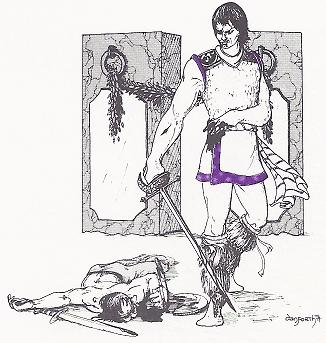
I've already posted a number of pieces of artwork from The Fantasy Trip. Here are some illustrations by Pat Hidy, whose artwork appears in several Metagaming microgame titles.

I always preferred the black and white Pat Hidy pieces. The color cover (above) of the Death Test microquest is by Pat Hidy, as is the black and white illustration (below) that appears on the inside front cover. I much prefer the illustration below. Thought I have little use for much of what comes out of The Forge, I do like this article entitled "Naked Went The Gamer" by Ron Edwards, about the sanitizing of Dungeons and Dragons art.


Edwards makes a good observation about this, and much of the other "controversial" D&D artwork from the late 70's. That artwork was naturalistic, while the recent artwork appearing in fringe fantasy games seem purposely risque or shocking. The above illustration is my favorite one from the TFT line.

I promised one of my commentors that I would post the "Oops, I crapped my pants" giant from Death Test. Here he is. This giant appears pretty formidable, but I have a difficult time taking his oversized diaper seriously.

Friday, March 4, 2011

The Fantasy Trip: Death Test Micro-Art

Following the huge success of Melee and Wizard, Metagaming released a long line of Microquest adventures, starting with Death Test. The Microquests were pre-programmed adventures, somewhat akin to the choose-your-own-adventure line of products. Thus, they were perfect for those who wanted to play a solo game of Melee or Wizard.

The original Death Test adventure hook was rather lame. The local overlord stocks a obstacle-course dungeon and sends potential hired goons through the labyrinth to test their mettle. You are one of those potential bands of hired goons.

The obstacle-course was a mixture of straight-up combat encounters, and gotcha traps. If you survived the Death Test (and the back cover warning was not hyperbole: this adventure was a KILLER) you arrived at the end of the obstacle-course and were either offered a job as a hired goon or were executed for running away from combats too many times. Harsh.


While the adventure hook was pretty lame, the gameplay was fun, and Metagaming's micro-art reached its zenith with Death Test. Pat Hidy was the illustrator for Death Test, and the most memorable adversary micro-art comes from the counter set that was included with this Microquest adventure.


Pictured, at the top, is a malevolent-looking dude that we used as an evil wizard, if that's what was called for in a particular combat. Looking at the figure now, i'm not sure why we thought he was a wizard, as he clearly possesses a battleaxe and shield, and has a sword strapped to his back.

Also included among the 35 Death Test counters, were seven goblins, six of which I have reproduced here. The most memorable goblins, for many of you, will be the first two: they appeared either in the Metagaming ads in Dragon Magazine, or on the back covers of the later Melee "boxed-set" back covers.

For those of you keeping score, you will note that five of the seven figures above are topless. I think its safe to conclude that Cidri, the assumed setting for The Fantasy Trip, is a jungle-world, where the climate is too hot for the employment of upper garments.