Saturday, June 12, 2010

What's In The Chest? Here's My Theory.

C'mon people, it's so obvious!

The fact that the contents are glowing can only mean one thing: inside the chest is Marcellus' soul. Using the wayback machine, Tarantino visited the past and implanted a suggestion in Trampier's brain to draw this illustration, as a teaser / promo for Pulp Fiction.

The dude in the back is Marcellus, and is wearing a full-head bandage. As everyone knows, in the Bible it states that the Devil takes your soul out the back of your neck. The Devil knows this, and took Marcellus' soul, but all that was available to him was a rusty battleaxe and so he botched the job, leaving Marcellus with a nasty head-wound.

The illustration is also performing double-duty as a teaser for Reservoir Dogs. Now that Jules and Vincent have recovered Marcellus' soul, Marcellus is going to torch the two henchmen.

Damn that Tarantino is clever!

Friday, June 11, 2010

Dave Trampier And Emirikol The Chaotic

Yesterday, I posted the stats for Emirikol the Chaotic, who makes an appearance in the 1998 Monte Cooke AD&D 2E adventure, A Paladin In Hell.

Emirikol is the much-beloved creation of illustrator David Trampier. Trampier, affectionately known as 'Tramp' by many of the older roleplayers, is an illustrator who, along with Erol Otus and David Sutherland, defined the look of early Dungeons and Dragons. Here is Tramp's Emirikol the Chaotic as he appears on page 193 of the 1979 AD&D Dungeon Masters Guide.

Tramp was well-known for utilizing "implied narrative" in his illustrations. He captures a moment in a story, already in progress, and he leaves it up to us, the viewers, to piece the rest of the story together. The subjects in his illustrations are rarely inert: even when pausing, they have a certain energy or tension to them. Look at any of his illustrations and you will see what I mean: even his crouching lizardman, from the Monster Manual, looks ready to spring to the attack.

Thursday, June 10, 2010

Emirikol The Chaotic

Here are the stats for Emirikol the Chaotic, as they appear in Monte Cook's adventure, A Paladin In Hell. It would have been so cool had they also provided a portrait of Emirikol, but sadly they did not.

The Adventure begins with the funeral of a paladin, with his body, the attendees and the entire temple being dragged into the depths of hell. The players set off to save the attendees, and recover the temple and the paladin's body, and discover why they were sucked into hell in the first place.

Emirikol acts as the adventurers' patron in A Paladin In Hell, gifting the adventuring party with an abyssal sailing ship, Demonwing, to aid them in their quest.

Why? Play the adventure, and find out for yourself...

ADnD 2nd Edition: A Paladin In Hell Adventure

Yesterday, I was asked where the colorized illustration of A Paladin In Hell comes from, a fragment of which appears in my banner.

It is a painting by Fred Fields, who was a regular AD&D 2nd edition artwork contributor from 1990-1998. This painting graces the cover of the 1998 2nd Edition Advanced Dungeons and Dragons adventure, A Paladin In Hell, by Monte Cook.

The adventure itself has attracted mixed reviews: while it is not my all-time favorite adventure, it's not bad, but I had to buy it, if simply for the cover.

Incidentally, Emirikol the Chaotic makes an appearance in this adventure.

Wednesday, June 9, 2010

A Paladin In Hell From The Players Handbook


Most of us are already familiar with this old-school classic, but here it is again: A Paladin In Hell, by David C. Sutherland, a black and white illustration appearing on page 23 of the 1978 Advanced Dungeons And Dragons Players Handbook (thank you, Akrasia, for the correction). This illustration ranks up there, with Emirikol The Chaotic and a few others, as my all-time favorite D&D artwork.

Tuesday, June 8, 2010

Hazarding Exposure To Call Of Cthulhu


I made mention earlier of the inspiration behind my blog title, A Paladin In Citadel. Part of the inspiration is from the classic Sutherland illustration, entitled A Paladin In Hell, from the original AD&D Players Handbook. The "Citadel" part of that blog title is now, hopefully, also clear.

What about the other part of the blog title, namely, being a Paladin? It surely does not stem from Paladin being my favorite character class, as I never played a Paladin, nor had interest in doing so. I always felt that the Paladin, and other specialist classes, paved the way for stat inflation and character-building systems, which both, in my mind, are anathema to the point of the original "old-school" character creation system -- the challenge of playing a character, based on what the dice present you, rather than what you wanted to play.

No, the reference to being a Paladin comes partly from what we played and how we played it. While there were lots of games we played back in the day, including several boardgames and microgames, you would never have described our gameplay as incorporating either "weird" or "horror" elements. As far as RPGs went, we played Dungeons & Dragons and Traveller, straight up. I was in a pretty white-bread gaming group.

Oh, sure, I was acquainted with Call Of Cthulhu, Arduin Grimoires, Tunnels & Trolls and the other alternative rpgs that sprang up in the late 70's and early 80's. But two things prevented a thorough introduction to any of them: one was cash (or lack thereof, I was in my tweens during the late 70's and early 80's and had neither a job nor regular allowance); the other was arrogance (thinking that first-to-market or biggest-in-market meant best). Until the mid-eighties, scraping enough money together to buy even the core D&D books or the occasional microgame was a challenge. Living in (rpg) poverty and being arrogant about your beliefs = Paladin.

Luckily, my brother did have a job, which meant there were boardgames and rpg books in the house, even if I was technically barred from accessing them (good luck with that).

So I did get exposed to a wide variety of games. But one of the few that I did not have the opportunity to experience was Call Of Cthulhu. Trey, the author of the blog From The Sorcerer's Skull, posted an entry recently, mentioning a Call Of Cthulhu monster encyclopedia, entitled Malleus Monstrorum. He, in addition to several other bloggers, are in the habit of posting interesting tidbits about games weird and horrible, of which many reference Call Of Cthulhu and Basic Role Playing.

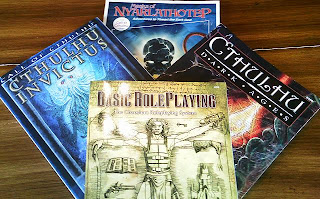
While my recent trip to The Sentry Box failed to yield a copy of Malleus Monstrorum, I have come into possession of several other BRP and Call Of Cthulhu resources, which I will bravely hazard exposure to, in the name of all that is good, light and true. They are:

  • Basic Role Playing: The Chaosium Roleplaying System -- this 400 page tome is (as I understand it) the underpinning for the Call Of Cthulhu game.
  • Cthuhlu: Dark Ages -- 175 pages of supplementary material, to allow you to set your Call Of Cthulhu game in the period around 1000 A.D.
  • Cthuhlu Invictus -- a 165 page Cthulhu Sourcebook, suitable for use in running an Ancient Roman Empire based campaign.
  • Masks Of Nyarlathotep: -- Chevski was sufficiently enthusiastic about this particular 160 page 1920's-setting Call Of Cthulhu adventure that I could not pass on the opportunity, when I discovered it on the used-game bookshelves at The Sentry Box.

Do I need to buy the Call Of Cthulhu rulebook, or is possession of the BRP book and the above supplements and adventure a suitably broad introduction to this game system?

APIC And The Missing Article

Considering that when I first posted background explaining the title of my blog, I had zero followers, I thought I would take a moment and again provide some of that detail.

I started playing Dungeons and Dragons with the original little brown books. It is in the mid-1970's, and I am in grade school. My older brother is a member of several wargaming clubs, at both the local college and university, and is resentful (as elder brothers are wont to be) at being forced to take me along to his weekend club meetings. It is at those club meetings that he becomes first acquainted with Dungeons and Dragons, and he brings the LBB's home, where they are discovered by me.

Several years later, I graduate to middle school, and the Advanced Dungeons and Dragons Dungeon Masters Guide is published (Editor: In fact, its 1978, and the Players Handbook, not the DMG. Thanks, Akrasia.), which includes the classic illustration by Sutherland, entitled "A Paladin In Hell". That illustration, along with several others in the DMG (and Players Handbook and Monster Manual) captures, for me, the D&D ethos.

The title of my blog, A Paladin In Citadel, is an homage to that classic D&D illustration, A Paladin In Hell. Living in Citadel, a community in northwest Calgary, I have, of course, replaced the word "Hell" with "Citadel" (this is not a comment on what I think of my community ... sometimes a cigar is just a cigar folks).

Someone emailed me, asking why my blog is not entitled "A Paladin In The Citadel", and noted that I am clearly missing the article "The" in my title. I hope the above explanation clears up any confusion about the missing article!

As for being A Paladin In Citadel, I can assure you that I have never played a Paladin, nor do I have any interest in doing so (my disinterest in playing any of the specialist classes -- other than the Bard -- is already well-known).

Sunday, June 6, 2010

Paladins Don't Just Rescue Damsels And Slay Dragons You Know

Paladins also have to mow the lawn. Here's another glorious day on the culdesac. What better way to spend your Sunday morning than to be out mowing and watering. Ah, the simple pleasures of adulthood and home-ownership!

The last time I posted a picture of the culdesac was back on December 5. I thought it would be worth posting another photo, to demonstrate that Calgary is not always gripped in the icy clutches of the Winter Warlock. We do get two weeks of summer every year.

Saturday, June 5, 2010

What Snacks Are Traditional When Playing Dungeons And Dragons?

I always presumed that Cheetos and Mountain Dew were the traditional snacks-of-choice whilst playing Dungeons and Dragons. Is that a manufactured memory, or is this really what the majority of D&D players were eating and drinking when they got together for game-night?

Bridge Mix is, of course, the preferred snack while playing Bridge. For our Settlers games, we tend to have Peanut M&M's, Wine Gums, Jube-Jubes and Skittles at the table (drinks being barred after the great Coca-Cola flood of 2009). We generally avoid greasy snacks like chips during boardgame nights, as chip-grease is not pleasant on the playing pieces and cards.

So what are your traditional D&D snack-foods and drinks for game night?

ODnD And Its Progeny

I was quite pleased to see that my second Swords & Wizardry Whitebox arrived in the mail several days ago. It was accompanied by five extra S&W Character books. That gives me seven Character books and two Spell books for players to share. I had ordered the extra Whitebox on the off-chance (subsequently confirmed) that my 11-year old son would be intrigued and want to read and have these rules manuals for himself.

Indeed, I found him immersed in the Monster book on Thursday evening, so I think his interest has been piqued!

We're off to the properties for a couple of weeks in July. There are eight cabins owned by our extended family, on the Shuswap Lake, all within a 5-minute walk of each other, and most of his D&D-playing cousins and aunts and uncles will be around. Having the extra books will be a boon, as i'm trying to wean my extended family off of the later editions of D&D.

I will also bring along the ODnD Collectors Edition ruleset and supplements, which is the parent of the new Swords & Wizardry Whitebox. This is sure to act as further inducement to join in our little old-school D&D games: who doesn't love leafing through these old booklets while you're waiting for your turn to roll-to-hit!