One of the features of ADnD that has always left me unsatisfied is variable damage by weapon. I have commented on this in the past, and since I just posted about weapon quality, I thought this would be an opportune time to post my recent thoughts on weapon selection.
I like to see players selecting weapons based on role-playing, not roll-playing: selecting a weapon based on their character template, rather than how much damage the weapon inflicts. ADnD makes that difficult, as there are weapons in ADnD that are clearly better from a min-maxing perspective. Why use a battleaxe (1d8/1d8) with a speed of 7 (slower) when you can use a longsword (1d8/1d12) with a speed of 5 (faster)?
As usual, Avalon Hill's Magic Realm (and to a lesser extent, Metagaming's Melee) comes to the rescue. In Magic Realm, all weapons are classified by their weight, and characters that are strong enough, can wield those heavier weapons, therefore inflicting more damage. All weapons in that weight category do the same damage. Melee uses a similar approach.
Marrying the Magic Realm and Melee weapon damage systems with Dungeons and Dragons provides me with the following solution.
Weapon Selection Table
Strength : Damage : Examples and Comments
Str 3 - 4 : Negligible (d3) : Blackjack, Knife, Dart, Stone
Str 5 – 7 : Light (d4) : Club, Dagger, Javelin, Hatchet, Sling bullet, Staff
Str 8 – 10 : Medium (d6) : Mace, Shortsword, Spear, Axe, Hammer, Arrow, Bolt, Pick
Str 11- 13 : Heavy (d8) : Flail, Longsword, Polearm, Battleaxe, Scimitar, Warhammer, Pickaxe
Str 14 – 16 : Tremendous (d10) : Maul, Greatsword, Lance, Greataxe, Morningstar, Mattock
Str 17 – 18 : Overswing (d12) : Can Overswing Tremendous Weapons For d12 Damage
Weapons that characters can use in combat, without experiencing fatigue, is based on their Strength. In addition, characters can overswing weapons in a lower weight category, raising the weapon's damage to the next higher damage category. That allows those characters to do extra damage with a weapon in a lower class.
For example, a Strength 12 Character can use a Longsword (d8). That Character can also overswing a Shortsword to bring it up to d8, from d6; or, can overswing a Dagger to bring it up to a d6, from a d4; or, can overswing a Knife to a d4, from d3.
Players are not restricted to weapons in, or below, their Strength category. For example, a Character with a Strength of 8 can still pick up and wield a Greatsword. However, since I use the longer, one-minute combat rounds, that Character suffers fatigue from swinging, parrying and blocking with the Greatsword, equal to the number of levels above the character's normal ability. Since the Greatsword is two levels above that character's normal ability, she suffers two fatigue (deducted from her hit points) every round she continues to wield the Greatsword in combat.
Sunday, May 30, 2010

Rules Transparency: Weapon Quality
There are two schools of thought regarding rules transparency. One school holds that the players should know the rules of the game, at the outset, to ensure that they have all the information they need to make good, in-game choices. Another school argues that the rules should be discovered, in-game, or should be common-sense rules that the players should know from real-life anyway.
Let me give you an example of a non-transparent rule. One of the rules I have often applied, but have not revealed to the players, is that the cost of an item is often, though not always, a good indicator of quality. This is a common-sense rule, but one that I do not explicitly reveal to the players prior to the game.
Let's apply that rule to the purchase of weapons.
In my games, second-hand weapons that are sold cheaply are often poorly made or badly maintained.
For those weapons that are new, but sold cheaply, it may be because the Weaponsmith knows they are brittle or soft, and so discounts the price of those less sturdy weapons. Alternatively, the weapons may have been made by one of her apprentices, whose skills are not up to the same standards as the master Weaponsmith.
Players will often want to haggle with the NPC Weaponsmiths and shopkeepers, to pay the least they can for their weapons. It can be tempting for the Players to purchase weapons that are cheaper, thus saving their coins for other purchases and activities.
Most weapons are worth between 3 and 15 coins. Light weapons that do 1d4 damage cost 1d6 coins. Medium weapons that that do 1d6 damage cost 2d6 coins. Heavy Weapons that do 1d8 of damage cost 3d6 coins. Tremendous weapons inflicting 1d10 damage cost 4d6 coins. I often allow the players to purchase whatever weapon they desire, designating what level of damage the weapon does. The player can then dice for the cost of the weapon, advising me as to the type and weight (damage level) of the weapon, and final purchase price.
Once the purchase price and weight (damage level) of the weapon is known, I roll a number of addition d6 so that the total number of dice rolled is 6. So for a medium weapon that costs 2d6, I roll an additional 4d6. I add the cost of the weapon, and my roll, and consult the following chart.
Weapon Quality Table
Score : Condition : Notes
6 – 11 : Flawed Weapon : breaks on first combat use
12 - 17 : Poor Quality: breaks on roll of 1, 2 or 3
18 – 24 : Average Quality : breaks on a roll of 1
25 – 30 : Excellent Quality : weapon gets saving throw on roll of 1
31 – 36 : Masterwork : roll 2 dice, weapon does higher damage
The result of this table (particularly for those more expensive weapons) is that players who pay very little for their weapons are more likely to find out the hard way that they got what they paid for. I do not reveal the above game mechanics however. Those players who decide to purchase items on the cheap will have to find out, during the game, that weapon cost and quality often go hand-in-hand.
Let me give you an example of a non-transparent rule. One of the rules I have often applied, but have not revealed to the players, is that the cost of an item is often, though not always, a good indicator of quality. This is a common-sense rule, but one that I do not explicitly reveal to the players prior to the game.
Let's apply that rule to the purchase of weapons.
In my games, second-hand weapons that are sold cheaply are often poorly made or badly maintained.
For those weapons that are new, but sold cheaply, it may be because the Weaponsmith knows they are brittle or soft, and so discounts the price of those less sturdy weapons. Alternatively, the weapons may have been made by one of her apprentices, whose skills are not up to the same standards as the master Weaponsmith.
Players will often want to haggle with the NPC Weaponsmiths and shopkeepers, to pay the least they can for their weapons. It can be tempting for the Players to purchase weapons that are cheaper, thus saving their coins for other purchases and activities.
Most weapons are worth between 3 and 15 coins. Light weapons that do 1d4 damage cost 1d6 coins. Medium weapons that that do 1d6 damage cost 2d6 coins. Heavy Weapons that do 1d8 of damage cost 3d6 coins. Tremendous weapons inflicting 1d10 damage cost 4d6 coins. I often allow the players to purchase whatever weapon they desire, designating what level of damage the weapon does. The player can then dice for the cost of the weapon, advising me as to the type and weight (damage level) of the weapon, and final purchase price.
Once the purchase price and weight (damage level) of the weapon is known, I roll a number of addition d6 so that the total number of dice rolled is 6. So for a medium weapon that costs 2d6, I roll an additional 4d6. I add the cost of the weapon, and my roll, and consult the following chart.
Weapon Quality Table
Score : Condition : Notes
6 – 11 : Flawed Weapon : breaks on first combat use
12 - 17 : Poor Quality: breaks on roll of 1, 2 or 3
18 – 24 : Average Quality : breaks on a roll of 1
25 – 30 : Excellent Quality : weapon gets saving throw on roll of 1
31 – 36 : Masterwork : roll 2 dice, weapon does higher damage
The result of this table (particularly for those more expensive weapons) is that players who pay very little for their weapons are more likely to find out the hard way that they got what they paid for. I do not reveal the above game mechanics however. Those players who decide to purchase items on the cheap will have to find out, during the game, that weapon cost and quality often go hand-in-hand.
Tuesday, May 25, 2010
Appendix N: Web Of The Spider
 "Girl," Ishcon interrupted, "do you know who rules this world?"
After a moment's hesitation, Tiana replied, "No one rules the world. A bunch of kings and such-like hollow-headed men pretend to."
At that moment, a dark shadow glided across the floor. Only a trick of the shifting light of these damned greasy torches, Tiana thought: yet Ishcon glanced about and she saw the desperate fury of a trapped animal flicker in his eyes.
"You do not understand and are wrong, he said in a sibiliant whisper. "You are better off not knowing: never mind. I dare not explain."
Such is the plot set-up for Web Of The Spider, the third and final book in the War Of The Wizards trilogy. Like the other books in the trilogy, Web Of The Spider is co-authored by Andrew Offutt, one of a select group of writers mentioned in Appendix N of the 1979 Advanced Dungeons and Dragons Dungeon Masters Guide.
Web Of The Spider was published in 1981, several years after the DMG was released. Co-authored by Andrew Offutt and Richard Lyon, the story clocks in at a respectable 268 pages, 60-plus pages longer than either of the first two books in the trilogy. The cover, by Rowena, shows a costumed Tiana, battling a fire-demon as she embarks on her quest to acquire the Skull Of He Who Sleeps. This book again features Tiana Highrider, Pirate Queen; Pyre of Ice and Ekron, two opposing sorcerers; and adds a new character, the nameless Gray Knight, whose face, memories and identity have been wiped clean by Pyre.
The Gray Knight is sent forth as Pyre's surrogate, in an effort to divine and prevent the latest plot of Ekron, whose earlier attempt, in The Eyes Of Sarsis, to awaken the Serpent of the World, had been foiled by Tiana and Pyre. Along the way, Pyre appears to the Gray Knight in mirrors, pools and other reflective surfaces, egging the Gray Knight on but never fully revealing what it is that the Gray Knight is expected to do.
Tiana, meanwhile, is on her own quest to discover who rules the world. Her companion: a skull, its jaws wired shut with silver, within which resides an impossibly-large ruby, nearly the size of the skull itself. Each time she removes the skull from its protective case, dread peril overtakes and nearly defeats her and her entourage.
And while the two sorcerers scheme against and battle each other, the real danger, the demonic ruler of the world, plots his final, horrifying, life-snuffing victory.
Like the other two books in the War Of The Wizards trilogy, this book is an entertaining, if imperfectly or perhaps ironically-rendered homage to the swords and sorcery genre. As fodder for role-playing game elements, this book is a gold-mine. Take, for example, the skull which Tiana finds. A better template for an artifact you will be hard-pressed to find. The island of the ruler of the world is truly a hellish place, and would be great fun to recreate as an adventure site. Temples to the Toad-god. Spider familiars that spin invisible nooses to strangle its master's betrayers. A ship crewed by the undead, which is the only safe passage to reach the ruler of the world. Desperate sea-battles against a fire-breathing dragon.
And then there is the mystery of the Gray Knight. He appears in the earlier books: how soon will you deduce his true identity?
Web Of The Spider is a fun read. While it's not for this book that Offutt is referenced in Appendix N -- that honour is bestowed upon him for his capable editorship of a fiction anthology, Swords Against Darkness III, for which he does not contribute a single story -- Offutt has a good grasp of swords and sorcery tropes, which he ably employs in his War Of The Wizards trilogy.
Monday, May 24, 2010
Rewriting The History Of Dungeons and Dragons

There is an old axiom: history is written by the victors. While I do not own the magazine from which the original article was drawn, there is a brief history of the origins of Dungeons and Dragons, appearing on page 29 of the Best of Dragon Magazine I. Written by Gary Gygax, it summarizes his take on the development of D&D. By the time Gary wrote that article, D&D was well on its way to becoming a huge hit. For me, and many others on the periphery of the hobby, that article became the accepted history of the game for many years. As Dave Arneson did not have his own pulpit from which to preach, few were aware of his perhaps different perspective on the development of the game. The internet has been of great assistance in providing us with a more varied and fulsome account of the early days of the hobby.
Dave Arneson, who is credited with co-authorship of Original Dungeons and Dragons, played a different variation of the game than was revealed in those early D&D rules. In Dragons At Dawn, D.H. Boggs attempts to recreate that game. Mr. Boggs also provides us with the following alternate history of the Dungeons and Dragons game:
"One of the wargame rulesets that became a big influence on Arneson's fantasy campaign had been co-authored by Gen Con founder Gary Gygax. After Arneson demonstrated fantasy roleplay gaming to Mr. Gygax in the fall of 1972, Gygax became extremely enthused, and offered to write up the rules for Arneson and publish them. Arneson had no means to attempt this himself at the time and young Dave [24] had collaborated once before on a set of naval rules with the nearly decade older [33] and well connected Gary, so he readily agreed to have Gygax take the lead on typing up and publishing the rules. He mailed Gygax a 16 page manuscript of his rules and consulted with him by phone. This collaboration led to the first published fantasy RPG game in 1974; a game that has continued to grow and attract new players. However the 150+ pages as published by Gygax and business partner Don Kaye were somewhat of a compomise between the way each author actually played, with by far the majority of the rules coming from Mr. Gygax. It was a similar, and yet in many respects, a very different game from what Arneson had been playing with his group in Minneapolis."
I think the subtext of this alternate history is interesting. We are fortunate to have a wealth of information about the early days, via the various discussion boards and gaming sites. I like to think that, some 35-40 years later, old hatchets have been buried, festering wounds have been lanced, and those on either side of the Gygax/Arneson authorship debate are sharing the same pub table, enjoying a couple of pitchers of beer, a plate or two of nachos, and swapping stories of memorable D&D campaigns of yore.
Sunday, May 23, 2010
Don’t ask me what you need to hit. Just roll the die and I will let you know.
 Tavis Allison and Cyclopeatron are musing about whether or not to reveal the target numbers for successful melee attacks to their players.
Dave Arneson has an oft-quoted saying: "Don’t ask me what you need to hit. Just roll the die and I will let you know." Essentially, Dave was advocating for keeping as much of the game mechanics off-stage as possible, thus allowing the players to immerse themselves in their characters and the world, rather than meta-gaming, or tailoring their play to the game mechanics.
While I concur with Dave's approach, and have been a vocal proponent of keeping much of the in-game mechanics behind the DM screen, both Tavis and Cyclopeatron make compelling arguments for (sometimes) revealing the to-hit numbers to the players.
The attached 'Percentage Index' table has been sitting on my computer desktop for several months. I think I came across it in one of my visits to the Original Dungeons and Dragons discussion boards. It seems rather Arnesian: rumor has it that, before the d10 and d20 became widely available, probability tables were constructed using the available dice-of-the-day, d6's. The above table allows you to calculate a d20/percentage probability from a throw of 2d6.
Dave Arneson was reportedly a fan of percentage systems. In my mind, I imagine this probability table hanging from Dave Arneson's DM screen, via a paper-clip, and, after calculating the percentage chance to hit, Dave peers over his screen and is saying, "Don’t ask me what you need to hit. Just roll the die and I will let you know."
Saturday, May 22, 2010
Will McLean Cartoons: Wizards And Their Familiars

Another Will McLean cartoon, this time from page 44 of the 1979 ADnD Dungeon Masters Guide. In the above cartoon, two mercenaries are holding a Magic-user's familiar hostage, and threatening to kill it if the MU makes a false move.
Part of the glorious mess of OD&D and AD&D was the imprecision of the rules. Frustrating, no doubt, to those of us who may have been rules-lawyers, but a tremendous boon to others who wanted to take a germ of an idea and create their own grand experiment with it.
The 'Find Familiar' spell was one of those glorious messes. In the DMG, Gygax writes, "Purposely killing or causing to be killed a familiar is most likely to find great disfavour with the gods...". What specific disfavour that might entail was left entirely up to the Dungeon Master. Did it mean you would have a -1 adjustment to your rolls for the remaining game session? Or perhaps that all similar animals attack you on sight from then on? Did you really want to know what your malicious DM was waiting to spring on you, should you 'accidently-on-purpose' step on your unwanted rat familiar?
Thursday, May 20, 2010
Is Dungeons and Dragons A Swords And Sorcery RPG?
 Considering that my introduction to swords and sorcery literature came long after discovering Dungeons and Dragons, I can perhaps be excused for failing to note the overt references to swords and sorcery in the D&D rulebooks of the day.
My earliest experiences with Dungeons and Dragons were in the campaigns run by friends of my older brother. Those campaigns were heavily informed by Mormon mythology: my character's name was Archeantus, and the other players had similar Book of Mormon names. I seem to recall us creeping through a cavern in one session, looking for the lair of the Gadianton Robbers.
Thus, my earliest D&D experiences were quite unlike those of you who were emulating the fantasy fiction of Howard, Lieber, Vance, Burroughs, Lovecraft and their ilk.
The earliest reference to swords and sorcery role-playing that I can find in D&D appears in the 1975 Greyhawk Supplement to the Original Dungeons and Dragons game. In that rulebook, Gary Gygax writes:
"If you enjoy fantasy you will never be sorry you were introduced to the swords and sorcery of DUNGEONS & DRAGONS games." - Greyhawk, pg. 3
And in the preface to the 1979 AD&D Dungeon Masters Guide, Gary Gygax makes the following remark:
No two (Advanced D&D) campaigns will ever by the same, but all will have the common ground necessary to maintaining the whole as a viable entity about which you and your players can communicate with the many thousands of others who also find sword and sorcery role playing gaming an amusing and enjoyable pastime." - DMG, pg. 8
It may simply be a function of my ignorance of the meaning of the term swords and sorcery, but I don't consider either Original or Advanced Dungeons and Dragons to be a swords and sorcery roleplaying game. Generic fantasy, perhaps. But not swords and sorcery.
There are many reasons I hold that view. Here are two.
First, the inclusion of Magic Users as a playable class seems antithetical to a swords and sorcery game: few S&S stories feature a spell-caster as protagonist, and where they do, they usually pay a steep price for dabbling in the dark arts. Most spell-casters in S&S literature are at best distrusted, at worst, they are the dread antagonists of the story.
Second, few if any S&S tales include demi-humans such as elves or dwarves as protagonists. Where they do appear, they are malicious spirits or fearsome creatures of the earth.
There are more than a few old-school bloggers playing swords and sorcery campaigns, but most have house-ruled D&D to more fully emulate the genre, or are using a different ruleset to capture the feel of swords and sorcery adventures.
Wednesday, May 19, 2010
Traveller: Firefly Class Frontier Trader
 Okay, i'm a geek, but one of the things I loved about Traveller and other science fiction roleplaying games was the starship blueprints.
My love affair with starships began, as was the case for many of us, with Star Trek. While I became acquianted with Star Trek through the television reruns, it was the Starfleet Technical Manual that cemented our relationship. I remember from 1975, my brother bringing home the Starfleet Technical Manual. Within that book were page upon page of blueprints for everything from Starships to Spacesuits, Planetary orbits to Phasers, Tricorders to Tridimensional Chess. I pored over that book for hours, carrying it with me to elementary school, and dreaming of being a starship captain.
I discovered Dungeons and Dragons via my brother in 1976, finally permitting the stuctured role-playing I craved. Traveller soon followed in 1978. I never played Traveller as much as I played Dungeons and Dragons, but I always had a soft-spot for that game. My favorite supplements were the ones with starship blueprints. Leviathan. Traders and Gunboats. Broadsword. Azhanti High Lightning. My favorite starship blueprints, by far, were for the Zhodani: many of those starships had a winged, spidery, almost Romulan quality to them. As I recall, Judges Guild produced some nice starship blueprints, though my collection of Traveller stuff is largely official GDW material.
Which brings me to Firefly. I missed Firefly while it was in distribution. I suppose the fact that Firefly was the brainchild of Joss Whedon, of Buffy the Vampire Slayer fame, kept me away. Having since purchased and watched the entire series and the related movie, Serenity, I can confidently say that, as far as science fiction television goes, Firefly is probably the closest we have ever, or will ever, see of a Traveller series.
As a fan of Traveller, I really like the Firefly universe. I also like the starship, Serenity, which has a high tech/low tech quality to it that I always identify as Travelleresque: in the Traveller games we played, we were always living hand-to-mouth, scrapping every last credit together to pay for the repair of a broken engine part or the fuel we needed for our next jump. In Firefly, the same desperate hand-to-mouth struggle exists.Several free blueprints for the Firefly starship exist on the internet. Some are designed to fit with the standard 1.5 m x 1.5 m blueprint grid used in Traveller. But my favorite Firefly blueprints are the ones found here, in this booklet. Though costlier than free, I absolutely love the level of detail they have provided, which brings me, full circle, to the Starfleet Technical Manual. The level of detail being provided in the Firefly Reference Pack seems absolutely decadent. But its the sort of decadence that only someone who would pore over a Starfleet Technical Manual at the age of eight can appreciate.
Tuesday, May 18, 2010
Appendix N: The Eyes Of Sarsis
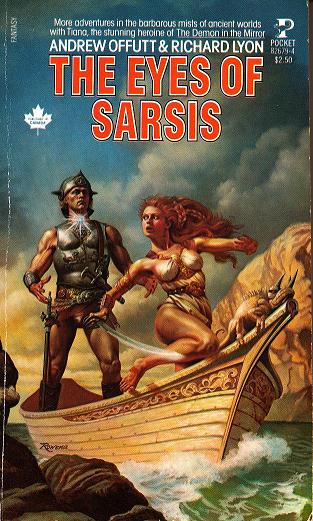 Last week, as part of my exploration of Appendix N of the Dungeon Masters Guide, I reviewed Demon In The Mirror by Andrew Offutt and Richard Lyon, the first of three books in the War Of The Wizards trilogy. Demon In The Mirror was written in 1978, one year prior to the publication of the Dungeon Masters Guide, and introduced several Wizards, several of whom fit the stereotypical sorcerer archetype from swords and sorcery pulp fiction. Those Wizards are introduced below:
Derramel: The antagonist of the first book, Demon In The Mirror. The sorcerer Derramel killed and imprisoned the family of our heroine, Tiana Highrider. Her quest to recover Derramel's severed body parts and reassemble them, in order to finally kill him and rescue her brother, is chronicled in Demon In The Mirror.
Ekron: We see very little of Ekron the sorcerer in Demon In The Mirror, although he is the catalyst for the first tale, setting off a chain of events that leads to Tiana's quest.
Sulan Tha: The White Wizard. Tiana was directed to kill Sulan Tha to obtain the head of Darramel. Instead, Sulan Tha offered the head freely to Tiana. Sulan Tha makes everyone uncomfortable, as he can see into their souls, and all the bad things they have done in their lives.
Pyre: Through much the first book, Demon In The Mirror, the sorcerer Pyre dogs Tiana and interferes with her attempts to retrieve the severed body parts of Derramel. He is ultimately unsuccessful in preventing her quest.
The second book in the War Of The Wizards trilogy is entitled The Eyes Of Sarsis. Again, it is co-authored by Andrew Offutt and Richard Lyon, and is published in 1980. It is about 205 pages, so about the same length as Demon In The Mirror, and is a brisk read.
As the story opens, we find our heroine, Tiana Highrider regaling a tavern full of pirates with a tale of high adventure regarding her victory over the dark wizard Derramel. As she reaches the climax of the story, she is simultaeneously interrupted by an attempt on her life (directed by a white cat wearing an ensorcelled gem), the introduction to a clue to the mystery of The Eyes Of Sarsis, and an attempted arrest by the town guard on a trumped up charge. It is really not her day.
The reason for the trumped up charge: her King wishes her to quest on his behalf, to rescue his daughter, who was been taken prisoner by Ekron. A classic Dungeons and Dragons adventure hook – how many times have we used the trumped up charge as an excuse to force the party to take up an adventure?
The title of the book refers to Sarsis, serpent of the world, which Ekron is trying to awake. For what purpose, we do not know. Tiana's ally in preventing the awakening of Sarsis: none other than Pyre, her nemesis from Demon In The Mirror!
This book series is called the War of the Wizards trilogy for good reason. There is a battle waging between Ekron and Pyre, and Tiana becomes a pawn in their struggle. The second book suffers for it: like a bad Dungeons and Dragons adventure, Tiana and the reader feel themselves railroaded in this second chapter of the War of the Wizards trilogy. The first and third books are much better in this regard. The principle cause of the railroading is due to the Eyes Of Sarsis conceit itself. The possessor of the Eyes of Sarsis is able to create convincing illusions, so much so that Tiana is constantly being misdirected and manipulated. You feel like the reader of a tale, at the end of which, the author declares, "and then I woke up."
If you intending to read this series by Offutt, there is little opportunity to avoid this weak middle chapter. Despite its failings, however, there is some value to reading this book, from an adventure-building perspective. There is a human-populated jungle-city, ruled over by the last vestiges of the serpent race that once dominated the world. There is also a secret death cult operating near the docks of another city, that Tiana defeats.
Having already read the third book in this series, The Eyes Of Sarsis is worth the read, if only to set you up for the final chapter, Web Of The Spider.
Saturday, May 15, 2010
Labyrinth Lord: Advanced Edition Companion

I'm such a Libra. I'm still on the fence when it comes to which retro-game is my favorite. I like Swords & Wizardry because it is the closest to original Dungeons and Dragons, and is incredibly rules-light. On the other hand, Labyrinth Lord is (in my mind) a superior implementation of B/X.
Happily, I don't have to choose between the two, I can have both! I picked up a copy of Advanced Edition Companion (AEC) for Labyrinth Lord from my FLGS, The Sentry Box, yesterday. As an active proponent of the FLGS system, I waited for it to arrive at the store. This meant having to wait an extra couple of months, compared to those of you who ordered it directly through Goblinoid Games or Lulu. For some reason The Sentry Box only ordered one copy, so my apologies to those of you in Calgary who were waiting for it to arrive: you'll have to ask Don to bring in another copy for you! I have not had a chance to dig into AEC, but I intend to give it a closer look on Sunday.
Here's a photo of my Swords & Wizardry boxed set, along with my Labyrinth Lord and Advanced Edition Companion books.
I also picked up used copies of DA3 and DA4, Dave Arneson's City of the Gods and The Duchy of Ten for Blackmoor. The two of them were too shy to pose for a picture -- perhaps they will discover their courage tomorrow.
Subscribe to:
Posts (Atom)