Sunday, April 11, 2010

Strange Symbol Found In The Dungeon


The adventure party comes across this symbol as they are exploring the dungeon.

It has been applied to the walls of the dungeon, in what appears to be some sort of phosphorescent white paint.

Saturday, April 10, 2010

Old School Monsters: Rust Monster


Here's another Will McLean cartoon from the Dungeon Masters Guide. This time, we have a couple of adventurers encountering a Rust Monster, one of Gary Gygax's unique monster creations. Here's what Gary had to say about the origins of the Rust Monster, from Dragon Magazine, Issue #88 (1984):

"When I picked up a bag of plastic monsters made in Hong Kong at the local dime store to add to the sand table array ... there was the figurine that looked rather like a lobster with a propeller on its tail ... nothing very fearsome came to mind ... Then inspiration struck me. It was a Rust Monster."

Both the Wizard and the Rust Monster have rather bemused looks on their faces. Of course, if I was a Fighter, fully decked in heavy metal armor, I would be fearful of the touch of the Rust Monster too. While the Rust Monster is not a terribly ferocious beast, one touch of its antennae and my armor crumbles to rust. Along with the Carrion Crawler and the Otyugh, the Rust Monster acts as garbage detail in the dungeon, cleaning up all the metallic discards while the other two monsters deal with the dead creatures and other organic waste.

Friday, April 9, 2010

Papers And Paychecks RPG

Papers and Paycheques is a great new fantasy role-playing game. You pretend to be workers and students in an industrialized and technological society. Or so goes the related promotional material.

In point of fact, this supposed preview is another knowing-wink, tongue-in-cheek cartoon by Will McLean, poking fun at the idea of role-playing games. The cartoon appears in the original Advanced Dungeons and Dragons DM's Guide. But instead of workers and students pretending to be adventurers, in this cartoon you have just the opposite.

This approach to D&D humor is typical for Will McLean's cartoons: he draws the reader in, by referencing some modern cultural reference, whether it be airplanes, poker, boardgames, mickey-mouse hats, television game-shows, backscratchers, or (in this case) role-players gathering for a friendly game.

Thursday, April 8, 2010

Player Versus Player In Old School D&D


Considering that Dungeons and Dragons was a product of wargamers, it should come as little surprise that there was a great deal of player versus player conflict in the early days of the game. Reading through the campaign accounts (certainly the ones being recounted by Gygax and his players) you will find numerous stories of players betraying each other.

The above cartoon from the pages of Dragon Magazine (yet another Will McLean original) shows a couple of adventurers playing poker, with one of the adventurers exclaiming of the winning adventurer, "Don't look now, Wiz, but isn't that a medallion of ESP he's wearing?"

Wednesday, April 7, 2010

Hunting Ogres With Will McLean

Here's another classic Will McLean Dungeons and Dragons cartoon: this time, he's spoofing on Metagaming's OGRE micro-game.

Two adventurers are standing in front of a sign, "Beware of the Ogre" and one is telling the other: "Boy, after that pair of giants and the nest of gargoyles, this should be a real pushover..."

Of course, the tread tracks from the Ogre (a cybernetic nuke-firing supertank) portend a grim fate for the two adventurers.

Tuesday, April 6, 2010

Will McLean Humor From The Dragon Magazine


Most of you are familiar with the cartoons of Will McLean, as they appear on the pages of the original Advanced Dungeons and Dragons Dungeon Masters Guide, authored by Gary Gygax.

Several of Will McLean's cartoon panels also appeared in The Dragon Magazine. The above cartoon appeared in Issue 24, April 1979, on page 18. The caption reads:

"Y'know, Wiz, when you said the treasure was guarded by two Fighters, I sort of figured you meant Lords or Myrmidons or something in that line."

In the early days of the hobby, it was not unusual to mix historical periods, with tanks existing along-side magic, and science fiction elements cropping up in medieval fantasy. Just look to Expedition To The Barrier Peaks, or Temple Of The Frog, for evidence of this cross-genre gaming.

This cartoon panel by Will McLean ably lampoons that early propensity for cross-genre gaming.

Monday, April 5, 2010

Monty Haul Campaigns And Will McLean


One of the thorniest problems facing the designers of early versions of Dungeons and Dragons was that of the Monty Haul campaign. Monty Hall (for those few of you unaware of the cultural reference) was the host of a game-show called "Let's Make A Deal", in which undeserving, ridiculously-costumed contestants would be asked to choose between three doors, behind one of which was hid a fabulous prize, with the other two, booby prizes.

Similarly, Monty Haul D&D campaigns were those campaigns where players were handed arbitrarily large experience points awards and fabulous treasures by the DM, and rarely faced any risks. Letters detailing the horrors of those campaigns literally filled the pages of early Dragon Magazines.

The above cartoon appeared in The Dragon, Issue 24, April 1979. Even at this early stage of D&D's history, the Monty Haul campaign had acquired such infamy that Will McLean was spoofing it.

More Old-School D&D Cartoons By Will McLean


Jim, of Carjacked Seraphim, reminded me of another classic Will McLean cartoon, this time from page 123 of Gary's DMG.

The adventuring party is trying to decide whether their newly found magic wand allows them to cast the various Bigby spells, or if they have found the fabled +2 Backscratcher.

Humor In Dungeons And Dragons


Perhaps i'm looking in the wrong places, but was seems to be missing from later versions of Dungeons and Dragons is a sense of humor.

In the early days, Will McLean was a cartoonist for the "Dragon Mirth" section of The Dragon magazine. His cartoons also appeared in other TSR publications, such as the Dungeon Masters Guide. The above cartoon is fondly remembered by many: it appeared on page 34 of Gary Gygax's DMG.

I loved Will McLean's cartoons. They captured a gonzo, self-deprecating, tongue-in-cheek attitude that was a welcome tonic to players and DMs taking themselves, and the game, too seriously.

Sure, Will McLean's cartoons were the throw-away lines, or the drum-roll-punctuated jokes, of the Dungeons and Dragons illustration universe. But that was part of the fun of D&D: getting together with friends, and sharing some fall-out-of your-chair laugh-fests. Early versions of D&D were that much the better, for having included humor in the game.

In Which Jean Wells Loses It: Or, "You're Playing It Wrong!"

I notice no small measure of condescension being heaped upon those who waste their time investigating, and writing about, the history of "the hobby."

This is unfortunate, as looking back allows us to see how we got to where we are today, and helps inform our understanding of the development of the game.

As I look through old issues of The Dragon, I can't help but be reminded of the challenges that the designers faced, in trying to communicate their expectations of how Dungeons and Dragons was to be played.

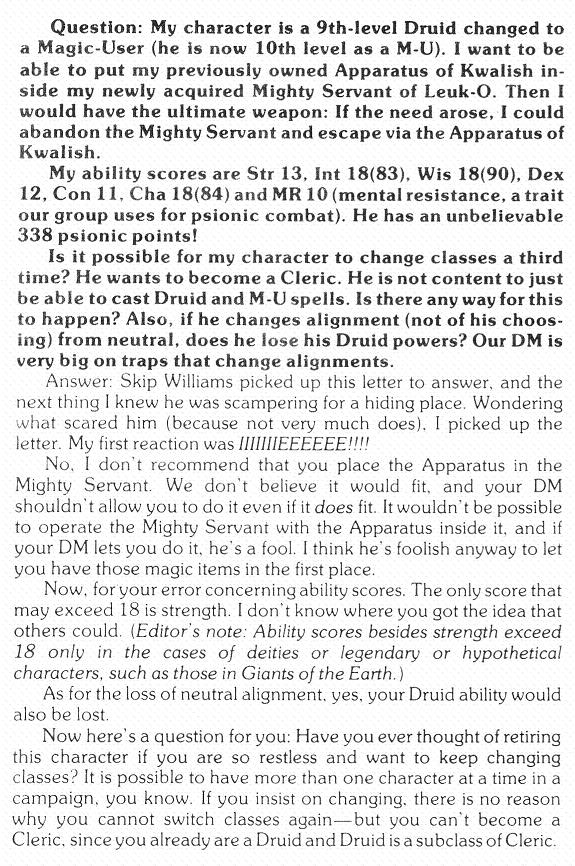
Here's a fine example of that challenge, from the Sage Advice column, authored by Jean Wells. This is from The Dragon, Issue #37, May 1980.

The question is posed: "How does my 9th level Druid / 10th Level MU, with 18.83 Int, 18.90 Wis and 18.84 Cha, combine his two artifacts, the Apparatus of Kwalish and the Mighty Servant of Leuk-O, to create the ultimate weapon, and can I triple-class, adding Cleric levels to the mix?"

Jean Wells' response: "My first reaction [after reading this letter] was IIIIIEEEE!"

You can read the entire question, and response, by clicking on the excerpt.

My point in posting this is that, in order to understand why the game evolved the way it did, you need to understand what feedback was being provided to the game designers. As you read through the editorials, letters to the editor, and articles in The Dragon, themes begin to emerge, revealing why the game developed (and continues to develop) the way it does.

Some final words from Jean Wells, in the same Sage Advice column: "Readers are once again reminded that Sage Advice is designed to settle specific questions concerning rule definitions or interpretations. General questions about procedure in an adventure or campaign should be handled by the DM of that campaign...."

I don't believe some of the more outrageous questions or situations were the norm. But those were the sorts of things that the game designers were reacting to. Any wonder that the rules became increasingly complicated and detailed, and the actions of the DMs and players increasingly proscribed.